
Justus Knight – RR News Update! June 21st, 2026
Welcome to Political Psycho Nation. This isn’t a recap show; it’s an ongoing education in political psychology. The Clinical Analysis: Tracking 8+ years of U.S. & global chaos. Subscribe to learn how power actually communicates. 🔒 Extended deep-dives & reports: www.restrictedrepublic.com
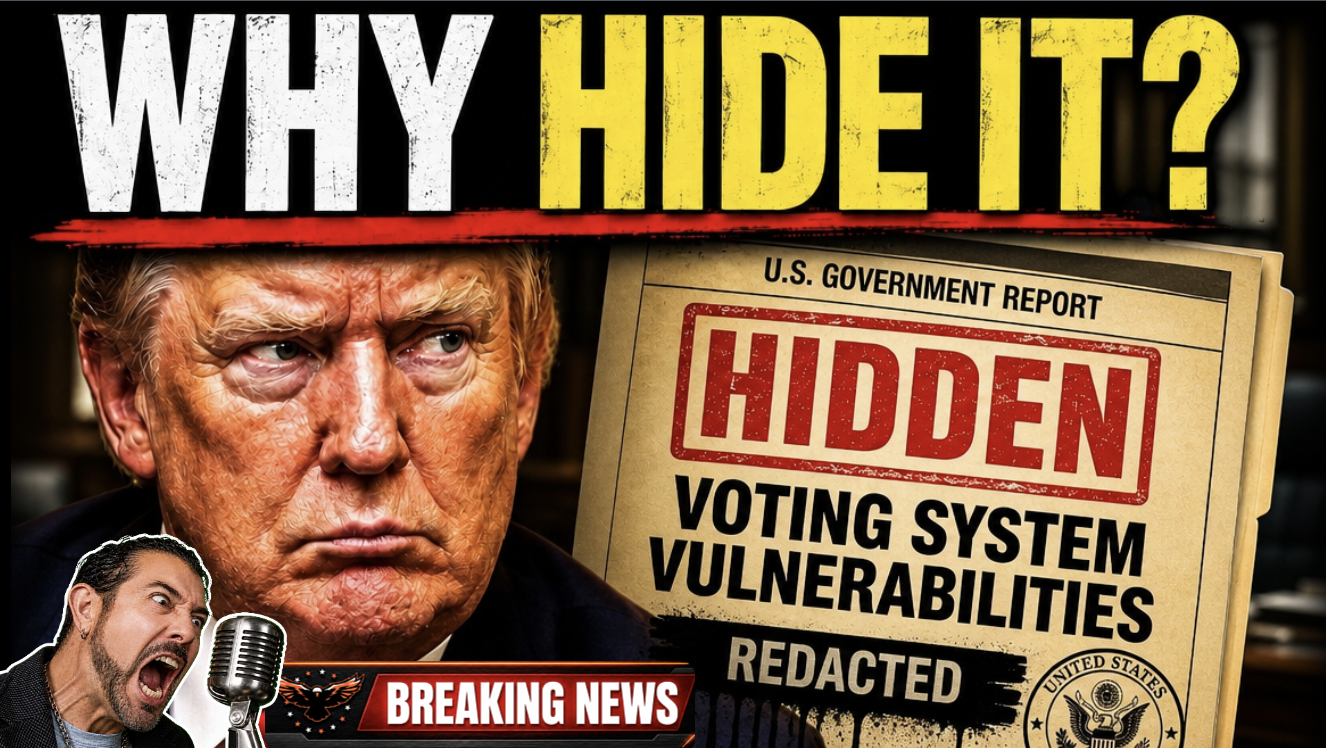
VIDEO TITLE: The Report Is Finished. So Why Won’t Trump Release It?
DESCRIPTION
#ElectionSecurity, #VotingMachines, #ODNI, #TulsiGabbard
Trump, the White House, ODNI, Tulsi Gabbard, and voting machine security are now at the center of a delayed election report raising new midterm questions.
A new Reuters report says White House officials have delayed the release of an ODNI voting machine study ahead of the 2026 midterms. The report reportedly identifies vulnerabilities in voting systems but does not claim votes were flipped. So why delay it? This episode breaks down the political psychology, the transparency problem, and the question both sides should be asking: if the report is done, why isn’t the public seeing it? Reuters reported the ODNI study flagged vulnerabilities such as outdated software and internet connectivity concerns, while also saying the report does not conclude those flaws changed votes.
🔔 Hit the notification bell and subscribe so you never miss a breakdown!
CHAPTERS
00:00 The Report Is Finished… So Why Won’t Trump Release It?
00:20 What Reuters Actually Reported
01:30 Vulnerabilities Are NOT Proof
02:15 Why This Report Creates Problems For Everybody
03:10 The Political Psycho Angle – Transparency
04:40 The Psychology of Non-Transparency – We Fill in the Blanks
06:10 Thank You Break
06:45 Protecting a Narrative Over Transparency
08:15 Why is It Power Over Public?
08:40 The Constitutional Question
09:30 Infrastructure Should Improve – Vulnerabilities Aren’t the Issue
10:50 Information Vacuums Get Filled
11:15 Trump – Release The Damn Report
Pinned Comment
Should Trump release the report? Yes or No?
HASHTAGS
#Trump, #ElectionSecurity, #VotingMachines, #ODNI, #TulsiGabbard, #2026Midterms, #PoliticalPsycho, #JustusKnight, #ElectionIntegrity, #WhiteHouse
Join Us At The Following:
- Restricted Republic News: https://restrictedrepublic.com
- Rumble: https://rumble.com/c/RestrictedRepubli
- Facebook (Justus Knight) : https://www.facebook.com/justus.knight.547/
- Facebook (Lisa Haven) : https://www.facebook.com/lisa0haven
- Instagram (Justus Knight) : https://www.instagram.com/justusaknight/
- Instagram (Lisa Haven) : https://www.instagram.com/lisa__haven/
- Truth Social: https://truthsocial.com/@RestrictedRepublic
- Telegram: https://t.me/restrictedrepublic
I love you all, until next time, Godspeed and God Bless,
Justus Knight
REFERENCES :Reuters (original reporting)
https://www.reuters.com/world/white-house-delays-release-us-voting-machine-study-midterms-near-2026-06-19/
FOX LiveNOW summary of Reuters report
https://www.livenowfox.com/news/report-white-house-delay-voting-machine-study
WTVB Reuters Syndication
https://wtvbam.com/2026/06/19/exclusive-white-house-delays-release-of-us-voting-machine-study-as-midterms-near/
Brennan Center – Voting Machine Accuracy & Election Safeguards
https://www.brennancenter.org/our-work/research-reports/voting-machine-accuracy
U.S. Election Assistance Commission (Voting System Testing & Certification)
https://www.eac.gov/voting-equipment
Cybersecurity & Infrastructure Security Agency (Election Security)
https://www.cisa.gov/topics/election-security
National Institute of Standards and Technology (Election Security Resources)
https://www.nist.gov/itl/voting
Because politics isn’t about what they say…It’s about what they’re trying to make you believe. Every broadcast decodes the real signals: what they emphasize, what they dodge, what they repeat, and what they’re quietly preparing you for. From presidential statements to geopolitical flare-ups and economic pressure campaigns, we connect the dots before the narrative becomes “official.”
This channel is built for people who can feel the manipulation — and want receipts. If you’re here for mainstream talking points and safe little opinions, keep moving.
If you want the truth behind the performance…Welcome to the Nation.
COMMUNITY QUIZ
Should the White House release the voting machine report immediately?
I don’t trust any version they release
Yes — public elections require public transparency
No — it could damage voter confidence
Release a redacted version
MEDIUM ARTICLE
The Report Is Finished. So Why Won’t They Release It?
A government report on voting machine vulnerabilities is reportedly complete.
The public can’t see it.
And that’s becoming a bigger story than the report itself.
According to Reuters, a study examining voting machine vulnerabilities ahead of the 2026 midterm elections has been delayed from public release. The report reportedly identifies vulnerabilities within election systems. At the same time, Reuters reported that the study does not conclude those vulnerabilities changed votes or altered election outcomes.
That distinction is critically important.
A vulnerability is not proof.
A weakness is not evidence.
A security concern is not confirmation that a system was successfully compromised.
In virtually every critical system we rely upon—banks, power grids, telecommunications networks, military systems, and even the smartphones in our pockets—vulnerabilities are regularly discovered. The existence of vulnerabilities does not automatically mean a breach occurred. It means a risk exists.
The same principle applies here.
Yet the public discussion surrounding elections has increasingly become trapped between two extremes.
One side often argues that questioning election infrastructure itself is irresponsible. The other frequently treats the discovery of any vulnerability as automatic proof that election outcomes were manipulated.
Reality rarely operates in extremes.
It is entirely possible for election systems to contain vulnerabilities while there remains no evidence those vulnerabilities changed votes.
And that is precisely why transparency matters.
If the report proves widespread manipulation, the public deserves to know.
If the report finds vulnerabilities but no evidence of manipulated outcomes, the public deserves to know that as well.
If the report identifies weaknesses that require correction before future elections, the public deserves to know that too.
The problem is not necessarily what the report contains.
The problem is that the public cannot read it.
Trust has become one of the most valuable—and fragile—commodities in modern society. Governments frequently speak about the importance of public confidence in elections. They emphasize the need to protect trust in democratic institutions.
But trust cannot be demanded.
Trust must be earned.
And transparency remains one of the most effective ways to earn it.
When information is withheld, people naturally begin filling in the blanks themselves. Human beings are pattern-seeking creatures. When facts are unavailable, speculation rushes in to occupy the vacuum.
History demonstrates this repeatedly.
The fastest way to fuel rumors is often not misinformation itself. It is the absence of information.
This creates a difficult paradox for institutions.
Officials may believe withholding information protects public confidence. Yet withholding information frequently produces the opposite result. It encourages suspicion, fuels speculation, and leaves citizens wondering what they are not being allowed to see.
The irony is that the public may be perfectly capable of handling nuance.
Most Americans understand that systems can have flaws without being fundamentally broken.
Most Americans understand that vulnerabilities can exist without proving catastrophic failure.
Most Americans understand that security improvements are an ongoing process rather than a one-time achievement.
What many Americans struggle with is being told to simply trust authorities while simultaneously being denied access to the evidence.
This issue extends far beyond elections.
It speaks to a broader question about the relationship between government and citizens.
Who ultimately owns information generated by public institutions?
Who decides what the public is allowed to see?
And at what point does protecting confidence become indistinguishable from controlling a narrative?
Those questions matter regardless of political affiliation.
They matter whether the administration is Republican or Democrat.
They matter whether the report validates concerns or challenges them.
Because transparency should not be conditional on whether the findings are politically convenient.
If the report is complete, release it.
Release the findings.
Release the recommendations.
Release the safeguards.
Release the vulnerabilities.
Allow citizens, experts, journalists, and election officials to evaluate the information for themselves.
Democratic institutions are strongest when they trust the public enough to show their work.
The report may ultimately reveal vulnerabilities.
It may reveal safeguards.
It may reveal both.
But until it is released, one question will continue to grow louder:
If the report is finished, why can’t the public see it?
Categories: Politics


Leave a comment