
Justus Knight – RR News Update! June 18th, 2026
Welcome to Political Psycho Nation. This isn’t a recap show; it’s an ongoing education in political psychology. The Clinical Analysis: Tracking 8+ years of U.S. & global chaos. Subscribe to learn how power actually communicates. 🔒 Extended deep-dives & reports: www.restrictedrepublic.com
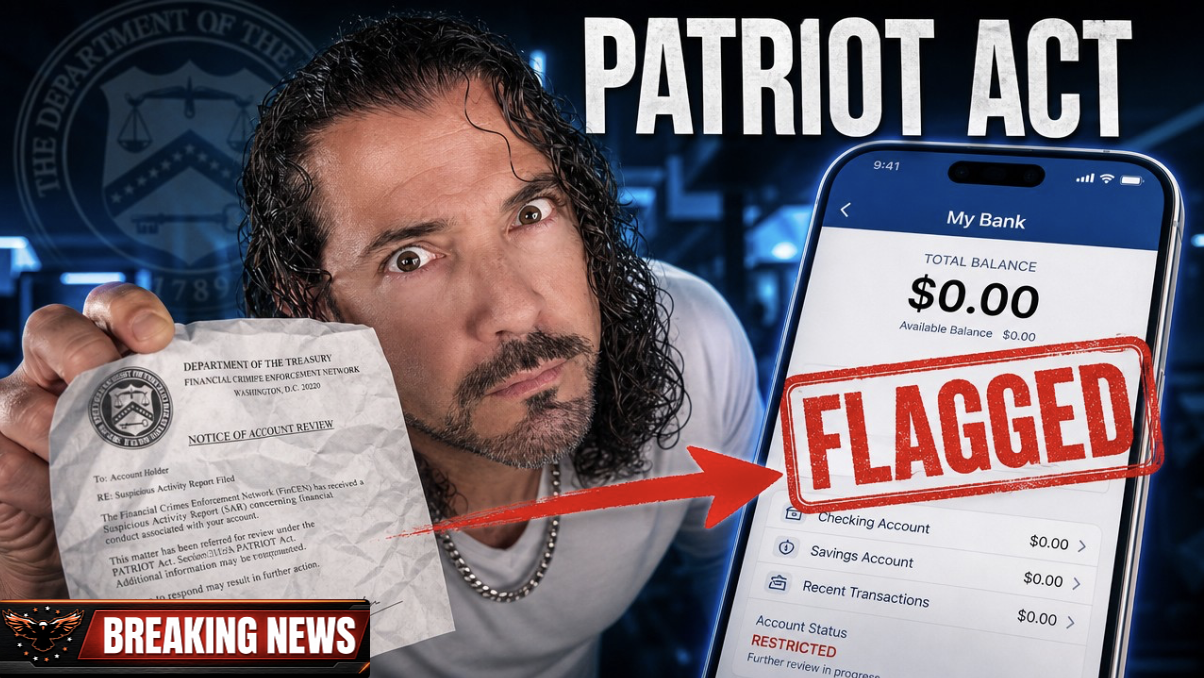
VIDEO TITLE: Trump Just Walked the Patriot Act Into Your Bank Account
DESCRIPTION
This morning on Political Psycho, Justus Knight breaks down a quiet but massive shift inside Trump’s Treasury Department and FinCEN: new banking guidance tied to immigration enforcement, fraud detection, payroll schemes, ITIN accounts, suspicious activity reporting, and Patriot Act Section 314(b) information sharing.
The question is simple: did Trump move the border checkpoint into your bank account?
Not literally — but functionally, Treasury is pushing banks deeper into the detection of immigration-linked financial patterns under fraud, anti-money-laundering, and financial-crime rules.
FinCEN says this is about unlawful employment risk, shell companies, payroll fraud, labor exploitation, and suspicious financial activity. Treasury says banks are not being turned into immigration officers. But the architecture tells a much bigger story: banks are becoming enforcement sensors inside a growing federal financial-surveillance system.
This is not just an immigration story. This is a financial privacy story. A Patriot Act story. A banking surveillance story. And a warning about what happens when government power gets outsourced through private institutions.
The border may still be a physical line — but the new checkpoint may be your bank account.
🔔 Hit the notification bell and subscribe so you never miss a breakdown!
In This Episode
00:00 — Did Trump Move the Checkpoint Into Your Bank?
00:45 — Treasury’s Quiet Banking Shift
02:00 — What FinCEN Actually Told Banks
07:30 — The ITIN Risk Factor Trap
10:00 — The Patriot Act Door Opens
12:00 — Treasury’s Official Defense
14:00 — Why This Is Bigger Than Trump
16:15 — Who Defines “Suspicious”?
17:40 — The New Financial Checkpoint
Pinned Comment
Did Trump just move the border checkpoint into your bank account — or is this just fraud enforcement finally catching up with the system?
The official answer is: banks are not being made immigration officers.
The uncomfortable answer is: they are being pushed deeper into detecting financial patterns tied to immigration, labor, fraud, and risk.
That’s the machine we’re dissecting this morning.
HASHTAGS
#Trump, #Treasury, #FinCEN, #Immigration, #PatriotAct, #FinancialPrivacy, #BankSurveillance, #Section314b, #SuspiciousActivityReports, #ITIN,
Join Us At The Following:
- Restricted Republic News: https://restrictedrepublic.com
- Rumble: https://rumble.com/c/RestrictedRepubli
- Facebook (Justus Knight) : https://www.facebook.com/justus.knight.547/
- Facebook (Lisa Haven) : https://www.facebook.com/lisa0haven
- Instagram (Justus Knight) : https://www.instagram.com/justusaknight/
- Instagram (Lisa Haven) : https://www.instagram.com/lisa__haven/
- Truth Social: https://truthsocial.com/@RestrictedRepublic
- Telegram: https://t.me/restrictedrepublic
I love you all, until next time, Godspeed and God Bless,
Justus Knight
REFERENCES :
https://home.treasury.gov/news/press-releases/sb0531
https://www.fincen.gov/sites/default/files/shared/314bfactsheet.pdf
https://www.fincen.gov/resources/section-314b
https://home.treasury.gov/news/press-releases/sb0523
https://www.fincen.gov/system/files/2026-06/FinCEN-Advisory-Non-Work-Authorized-Populations.pdf
https://home.treasury.gov/news/press-releases/sb0533
https://apnews.com/article/banks-immigration-trump-bessent-0b4bb2a1a392024b50b4cefeb7400ecd
White House — The SAVE America Act
https://www.whitehouse.gov/saveamerica/
Bipartisan Policy Center — Five Things to Know About the SAVE America Act
https://bipartisanpolicy.org/article/five-things-to-know-about-the-save-act/
Because politics isn’t about what they say…It’s about what they’re trying to make you believe. Every broadcast decodes the real signals: what they emphasize, what they dodge, what they repeat, and what they’re quietly preparing you for. From presidential statements to geopolitical flare-ups and economic pressure campaigns, we connect the dots before the narrative becomes “official.”
This channel is built for people who can feel the manipulation — and want receipts. If you’re here for mainstream talking points and safe little opinions, keep moving.
If you want the truth behind the performance…Welcome to the Nation.
COMMUNITY QUIZ
Do you think banks should be used as part of immigration-related fraud enforcement?
A. Yes — follow the money
B. No — banks should stay out of immigration
C. Only for clear criminal networks
D. This is financial surveillance wearing a badge
SCRIPT
This morning, the answer is yes — not literally, but functionally.
Trump did not put a Border Patrol booth inside your Wells Fargo.
But Treasury just pushed America’s banks deeper into the immigration enforcement machine by telling financial institutions to watch for suspicious financial patterns tied to unauthorized labor, payroll fraud, ITIN-related accounts, shell companies, and employment schemes.
So the border checkpoint did not move into your lobby.
It moved into the risk model.
That means your bank account, your deposits, your transfers, your payroll patterns, your IP address, your device data, and even bank-to-bank information sharing may now become part of a wider federal detection system.
And that is the part nobody is talking about.
Because this is not just an immigration story.
This is not just a Trump story.
This is the moment the government looks at the banking system and says:
“We can’t see everything. But you can.”
And brother, when Washington starts outsourcing surveillance to the private sector, liberty doesn’t disappear with a bang.
It gets flagged for review.
Welcome back to Political Psycho.
Pull up a chair, pour the coffee, and keep one eye on your checking account, because this morning we are following the money.
And that is not my phrase.
That is basically Treasury’s phrase.
Treasury Secretary Scott Bessent told bankers in Houston that Washington cannot identify every suspicious transaction, payroll scheme, or attempt to move illicit funds through the financial system.
Then he looked at the banks and said, in effect:
You can.
And that right there is the story.
Because the government does not have to put a federal agent on every corner when it can deputize the systems you already use every day.
Your bank.
Your payment app.
Your payroll processor.
Your wire transfers.
Your check deposits.
Your account opening paperwork.
The modern surveillance state does not always kick down your door.
Sometimes it asks for your routing number.
2:00 — What Actually Happened
Let’s walk through the paper trail without lighting our hair on fire.
On June 5, FinCEN — that is the Financial Crimes Enforcement Network inside Treasury — issued a joint advisory to banks and financial institutions.
The advisory tells them to be vigilant for suspicious activity connected to fraud schemes involving unlawful employment and non-work-authorized populations.
Translation into human English:
Banks are being told to watch for financial patterns that may indicate employers are using unauthorized labor, hiding payroll, avoiding taxes, using shell companies, or moving money in suspicious ways.
Now, on its face, that sounds reasonable.
Nobody here is defending payroll fraud.
Nobody here is defending identity theft.
Nobody here is defending crooked labor brokers stuffing workers into a financial blender while some shell company magically forgets how payroll taxes work.
That stuff deserves sunlight.
But here is where the story grows horns.
The advisory does not just talk about cartel finance or obvious criminal networks.
It also points banks toward customer-level signals.
SSN mismatches.
ITIN usage.
Foreign identity documents.
Recurring check deposits.
Cash withdrawals.
P2P payments.
Remittances.
Certain industries like agriculture, construction, hospitality, domestic service, and staffing.
And then it says banks should look at the totality of the circumstances.
That phrase sounds responsible.
It also sounds like the opening sentence to a 400-page compliance nightmare.
Because once the government says, “Look at the totality of the circumstances,” the bank hears:
Build a risk model.
Create flags.
Train employees.
Monitor accounts.
File reports.
Don’t miss anything.
And if you do miss something, enjoy your regulator colonoscopy.
Washington calls it guidance.
Banks hear it as a warning shot.
3:25 — The ITIN Trap
Now let’s talk about the part that makes this radioactive.
ITINs.
An ITIN is an Individual Taxpayer Identification Number.
It is used by people who are not eligible for a Social Security number but still need to comply with tax rules.
The FinCEN advisory says ITINs do not authorize legal work and do not prove legal immigration status.
That is factually true.
But then it says banks are encouraged to consider the use of an ITIN as a possible risk factor in certain account-opening or credit situations.
And there is the tripwire.
Because once something becomes a “risk factor,” it becomes a file.
Once it becomes a file, it becomes a category.
Once it becomes a category, it becomes a filter.
And once it becomes a filter, congratulations, you have built yourself a nice little machine.
And machines do not understand nuance.
Machines do not know whether someone is just trying to pay taxes, send money home, open a legitimate account, or commit fraud.
Machines know boxes.
Green box.
Yellow box.
Red box.
And once the box turns red, everybody in the system starts pretending the algorithm is a priest.
Now to be fair, FinCEN specifically says no single red flag proves suspicious or illicit activity.
That matters.
That is the line that keeps this from becoming open season on everybody with an ITIN.
But let’s be adults.
The government can say “no single red flag is determinative” all day long.
Banks still have to manage risk.
And when regulators are watching, banks tend to overcorrect.
Because no banker wants to be the one sitting in a hearing explaining why they ignored the red flag manual.
So the quiet danger here is not that every ITIN account gets shut down tomorrow.
The danger is that financial institutions start treating entire categories of people, businesses, industries, and transaction patterns as radioactive.
Not because the law directly commanded them to.
Because the incentives did.
And incentives are where liberty goes to get mugged in an alley.
5:00 — Section 314(b): The Patriot Act Door
Now here comes the second document.
June 12.
FinCEN updates its Section 314(b) fact sheet.
That section comes from the USA PATRIOT Act.
Yes, that Patriot Act.
The “temporary emergency tool” that apparently bought a house, had kids, and is now running the neighborhood watch.
Section 314(b) allows financial institutions to voluntarily share information with each other under a safe harbor when they are trying to identify and report possible money laundering, terrorist financing, fraud, and other specified unlawful activity.
Again, on paper, that makes sense.
If a fraud ring is hopping from bank to bank, one bank may only see one piece of the puzzle.
Bank A sees one account.
Bank B sees another.
Bank C sees the cash-out.
Put the pieces together, and maybe you catch the network.
That is the legitimate argument.
But here is the Political Psycho question:
What happens when the definition of suspicious activity keeps expanding?
Because that is how these systems grow.
They do not usually grow by saying, “We are here to monitor ordinary Americans.”
No, no, no.
That would be too honest.
They grow through categories.
Fraud.
Terror finance.
Cartels.
Human smuggling.
Payroll schemes.
Sanctions evasion.
National security.
Financial integrity.
Every category sounds serious.
Every expansion sounds reasonable.
Every warning comes with a scary villain attached to it.
And then one day, your bank is not just a bank.
It is a sensor.
A sensor in a national compliance grid.
And the funniest part — by funniest, I mean spiritually exhausting — is that Section 314(b) is called voluntary.
Voluntary.
That magical Washington word.
Like when your boss says the Saturday meeting is optional, but somehow everyone who skipped it is unemployed by Monday.
Banks know how this game works.
If Treasury strongly encourages something, if regulators support it, if law enforcement wants it, and if the headlines are screaming about fraud, cartels, and illegal labor, then “voluntary” starts wearing a fake mustache.
6:45 — The Government’s Defense
Now, to be fair, Treasury is not saying, “Banks are immigration officers.”
In fact, Bessent said exactly the opposite.
He said the advisory does not ask banks to become immigration officers.
He said it asks banks to do what they do best:
Know their customers.
Identify risk.
Recognize suspicious patterns.
Report illicit activity.
That is the official defense.
And it is not nothing.
There is real fraud in this country.
There are real shell companies.
There are real labor brokers exploiting real people.
There are businesses cheating the system, undercutting competitors, hiding payroll, and treating workers like disposable equipment.
So yes, enforcement matters.
But the problem is not the target.
The problem is the tool.
Because the same tool used to catch a criminal network can also create a chilling effect for lawful people who simply look risky to a compliance model.
And once the banking system becomes the enforcement layer, there is no clean line anymore.
Is the bank monitoring fraud?
Immigration status?
Payroll abuse?
Human trafficking?
Tax evasion?
Worker exploitation?
All of the above?
Congratulations. You just described the modern federal smoothie.
Throw everything in the blender, hit “national security,” and pretend the taste is constitutional.
8:00 — Mid-Video Hook
And this is where the story gets bigger than Trump.
Because today, some people will cheer this because they like the immigration enforcement angle.
Tomorrow, those same people may hate it when the same financial-surveillance logic is used against their industry, their donors, their political movement, their purchases, their speech-adjacent activity, or whatever Washington decides is suspicious next week.
That is why you do not judge power by whether your guy is holding it.
You judge power by what your enemy could do with it later.
That is the test.
And most people fail it spectacularly.
They see a machine pointed at somebody they do not like, and they clap like trained seals.
Then the machine rotates ten degrees.
Suddenly, everybody becomes James Madison with a podcast.
8:50 — The Real Question
So the real question is not:
“Should the government stop payroll fraud?”
Yes.
Obviously.
The real question is:
How much financial surveillance are we willing to normalize to do it?
Because this is the new battlefield.
Not just speech.
Not just guns.
Not just elections.
Money.
Access.
Accounts.
Compliance.
Risk scoring.
Your ability to participate in normal life.
You can survive being yelled at online.
You can survive a bad news cycle.
But if the banking system decides you are too risky, too complicated, too controversial, or too much paperwork?
That is not a debate.
That is economic oxygen being turned down by people who never have to face you.
And that is why this story matters.
Because when the government says banks should watch suspicious activity, the average person thinks:
Good, catch criminals.
But the deeper question is:
Who defines suspicious?
Who audits the model?
Who protects the innocent?
Who stops over-compliance?
Who makes sure lawful customers are not shoved out of the financial system because a risk algorithm got spooked?
And who pays the price when the system gets it wrong?
Spoiler alert:
It is usually not the people who wrote the guidance.
They get speaking fees.
You get frozen out.
10:05 — Closing
So yes, Treasury says this is about fraud.
FinCEN says no single red flag proves wrongdoing.
Bessent says banks are not becoming immigration officers.
All of that matters.
But the architecture matters too.
And the architecture is clear:
More bank monitoring.
More bank-to-bank information sharing.
More suspicious activity reporting.
More pressure on financial institutions to detect behavior the government cannot see by itself.
And whether you love Trump, hate Trump, or just want Washington to stop turning every problem into a surveillance pilot program with better stationery, this is where you should pay attention.
Because the border may still be the physical line.
But the new checkpoint may be your bank account.
And if that does not wake people up, nothing will.
Welcome to the age of financial enforcement.
Where your money does not just move.
It talks.
And now Washington wants the banks to listen.
I’m Justus Knight.
This is Political Psycho.
And this morning, the paper trail did not lead to the border.
It led straight to the teller window.
Categories: Politics


Leave a Reply