
Justus Knight – RR News Update! June 12th, 2026
Welcome to Political Psycho Nation — where politics gets dissected like a crime scene. With 1,000+ broadcasts and 8+ years tracking U.S. and global chaos, this isn’t some polite “both sides” recap show. This is psychological warfare analysis — breaking down the power moves, the media scripting, and the language leaders use when they’re trying to sell you a story.
If you want to understand how power actually communicates—subscribe. For extended reports and exclusive content, visit: www.restrictedrepublic.com
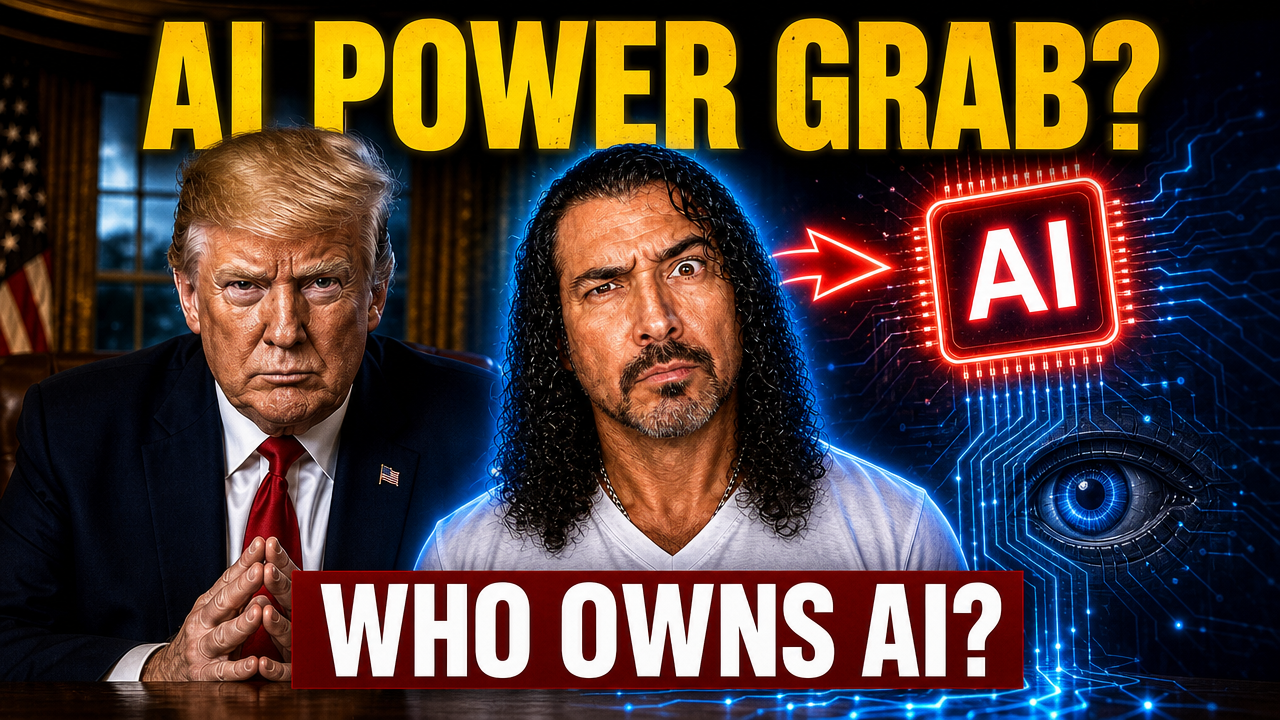
VIDEO TITLE: Trump Wants First Look At AI… Then Floats Owning A Piece
DESCRIPTION
President Trump’s AI policy raises new questions about early federal access to advanced artificial intelligence models, national-security adoption, and the possibility of public or government stakes in major AI companies.
President Trump’s artificial intelligence agenda is moving fast. First came a new AI cybersecurity order involving early federal access to certain advanced frontier AI models before broader release to trusted partners. Then Trump said his team would “look into” the idea of Americans gaining a stake in major AI companies, with later comments suggesting top AI firms may be asked to “give back” to the public.
In this Political Psycho breakdown, Justus Knight examines the real question under the surface:
If Washington gets an early look at the most powerful AI models, and then starts discussing ownership stakes in the companies building them, where does cybersecurity end and government leverage begin?
This is not anti-AI. This is not a legal accusation. This is about transparency, public benefit, national security, market power, Big Tech, and who gets access to the strongest version of the future before everyone else.
In This Episode
00:00 — First Look, Then A Piece
01:00 — The Two Moves Nobody Connected
03:50 — Cybersecurity Or Positioning?
05:20 — Voluntary, With A Heavy Smile
07:30 — The Money Question
09:40 — Trusted Partners And The Access Class
12:15 — Access Is The Asset
13:25 — National Security Gets Plugged In
15:15 — The Public Version Problem
17:05 — Final Verdict: Who Gets AI, And Who Gets Paid?
Pinned Comment
The question is not just who gets the most powerful AI first. The question is what happens when the same government asking for early access also starts floating ownership stakes in the companies building it.
HASHTAGS
#ArtificialIntelligence, #AI, #Cybersecurity, #NationalSecurity, #TechPolicy,
Join Us At The Following:
- Restricted Republic News: https://restrictedrepublic.com
- Rumble: https://rumble.com/c/RestrictedRepubli
- Facebook (Justus Knight) : https://www.facebook.com/justus.knight.547/
- Facebook (Lisa Haven) : https://www.facebook.com/lisa0haven
- Instagram (Justus Knight) : https://www.instagram.com/justusaknight/
- Instagram (Lisa Haven) : https://www.instagram.com/lisa__haven/
- Truth Social: https://truthsocial.com/@RestrictedRepublic
- Telegram: https://t.me/restrictedrepublic
I love you all, until next time, Godspeed and God Bless,
Justus Knight
REFERENCES :
Because politics isn’t about what they say…It’s about what they’re trying to make you believe. Every broadcast decodes the real signals: what they emphasize, what they dodge, what they repeat, and what they’re quietly preparing you for. From presidential statements to geopolitical flare-ups and economic pressure campaigns, we connect the dots before the narrative becomes “official.”
This channel is built for people who can feel the manipulation — and want receipts. If you’re here for mainstream talking points and safe little opinions, keep moving.
If you want the truth behind the performance…Welcome to the Nation.
📊 COMMUNITY QUIZ
What worries you most about the future of AI?
A. Government getting early access
B. Big Tech controlling the strongest models
C. Government owning stakes in AI companies
D. The public getting the watered-down version
SCRIPT
President Trump’s AI order already raised one giant question:
Why does Washington get an early look at the most powerful artificial intelligence before the public does?
But then came the money question.
Trump said his team would look into Americans getting a stake in major AI companies.
So now we are talking about early access…
and possibly ownership.
Cybersecurity is the public explanation.
Fair enough.
But when government gets a first look at the technology, then starts talking about who gets a piece of the companies building it…
that is not just policy.
That is power.
And somebody better ask who is holding the keys.
8-MINUTE TELEPROMPTER SCRIPT
Trump Wants First Look At AI… Then Floats Owning A Piece
00:00 — Cold Open: First Look, Then A Piece
Good morning, folks.
President Trump’s AI order already had one line almost nobody was talking about.
Before some of the most powerful artificial intelligence models reach the public, the federal government may get a look first.
That sounds harmless.
Cybersecurity.
Safety testing.
National security.
Very official. Very polished. Very Washington.
But then the story got even stranger.
Trump said his team would look into the idea of Americans getting a stake in major AI companies.
So let me get this straight.
Washington may get an early look at the technology…
then Washington starts floating the idea of owning a piece of the companies building it?
I’m not calling that insider trading.
I’m just saying if the referee asks for the playbook, then starts pricing jerseys and buying part of the team…
maybe somebody should check the scoreboard twice.
Because the future may not arrive as a ban.
It may arrive as a guest list.
Then an equity stake.
And regular Americans may still be standing outside the door.
01:00 — The Two Moves
This story is not about robots taking your job.
That horse is dead, buried, dug back up, monetized, and turned into a podcast.
This is about two moves happening back-to-back.
Move one:
The federal government wants a framework where leading AI developers can submit advanced models for review before broader release.
The pitch is cybersecurity.
The concern is access.
Move two:
Trump then talks about AI companies giving something back to the public, possibly through some kind of stake.
The pitch is public benefit.
The concern is leverage.
Now, both ideas can sound reasonable on their own.
Testing powerful AI for cyber risk?
Fine.
Making sure the American people benefit from trillion-dollar AI companies?
Also fine.
But put them together and the story changes.
Because now the question is not only:
Who gets AI first?
The question becomes:
Who gets AI first…
and who gets a piece of the companies after seeing what is behind the curtain?
That is the lane.
First access.
Then ownership talk.
That is not a conspiracy theory.
That is a conflict-of-interest question with a haircut and a press badge.
02:00 — Cybersecurity Or Positioning?
Let’s be fair.
The public explanation is not crazy.
AI can help find software weaknesses faster.
It can strengthen cyber defense.
It can protect critical systems.
Banks.
Hospitals.
Utilities.
Government networks.
Infrastructure.
And yes, America needs to know if the most advanced models can create new cyber problems before they hit the open market.
That part makes sense.
But good intentions do not erase dangerous architecture.
A policy can be built for defense and still create a gate.
And once there is a gate, the only question that matters is:
Who holds the key?
If federal officials get early access to frontier AI, they may see capabilities before the public does.
They may understand weaknesses before competitors do.
They may help define what counts as safe, acceptable, trusted, or too risky.
Again, that does not automatically mean something illegal is happening.
We are not doing tinfoil karaoke in the driveway.
But it does mean a new layer of power is being built.
Not around oil.
Not around land.
Around intelligence itself.
And when access to intelligence becomes managed, opportunity becomes managed too.
That is the story.
The future may not be blocked.
It may be tiered.
And the first tier is where the money lives.
03:05 — Voluntary, But With A Very Heavy Smile
Now let’s talk about the word voluntary.
The White House says this order does not create mandatory licensing, pre-clearance, or permitting for AI models.
That matters.
This is not written as a formal permission-slip system.
But anyone who has watched Washington operate for more than twelve minutes knows voluntary can show up wearing concrete boots.
Imagine you are an AI company.
You want federal contracts.
You want agency relationships.
You want national-security credibility.
You want regulatory goodwill.
You want the market to believe you are safe, serious, and patriotic.
Then the government says:
“We have a voluntary framework. Would you like to participate?”
That is not your buddy asking if you want wings during the game.
That is Washington holding the guest list and asking if you want to stay in good standing.
No boot required.
Just pressure in a suit.
And now add the second piece.
The same government building that early-access room is also talking about public stakes in AI companies.
Suddenly the handshake gets a little more interesting.
Because if Washington is both evaluator and potential financial stakeholder, the public deserves answers.
Who decides which companies qualify?
Who decides which companies are trusted?
Who decides which companies get meetings, protection, contracts, attention, credibility, and maybe government-backed public benefit structures?
And who gets left on the curb holding a pitch deck and a box of stale donuts?
This is where policy becomes power.
The order does not need to say control to create influence.
It only needs to create the room where influence happens.
And once that room exists, everybody important wants a chair.
04:20 — The Money Question
Now here comes the part that turns this from a tech-policy story into a Political Psycho episode.
Trump said his team would look into the U.S. taking stakes in AI companies.
Then he later talked about top AI companies giving back to the public, saying the public could become very rich.
On paper, that sounds populist.
And let’s be honest.
There is an argument here.
If AI companies are going to reshape the labor market, automate white-collar work, consume massive energy, rely on public infrastructure, and create unbelievable private wealth, why should the American people get nothing but a chatbot and a pink slip?
That is a real question.
But here is the other question.
Who controls the public stake?
Because “the American people own a piece” sounds beautiful.
Until you realize Washington would probably be holding the keys, naming the managers, shaping the rules, picking the winners, and calling it public benefit.
That is where the smell changes.
The idea could be sold as fairness.
It could also become a government-Big Tech alliance with a red-white-and-blue sticker slapped on the hood.
Imagine the pitch:
“We are not regulating them. We are partnering with them.”
Lovely.
Nothing says free market like the government asking for early access, then wondering how much of the company belongs in Uncle Sam’s garage.
Again, I am not saying this is insider trading.
I am saying if the government gets early access to the product, helps define its risk, shapes the release environment, meets with the executives, and then talks about equity…
maybe someone should install a few windows in that room.
Because sunlight is not anti-technology.
Sunlight is anti-swindle.
05:35 — Trusted Partners And The Access Class
Now listen to this phrase:
Trusted partners.
Sounds clean.
Sounds professional.
Sounds like a conference badge with bad coffee.
But trusted partners matter.
Because once the government and AI companies create an early-access lane, someone gets invited first.
Big banks?
Defense contractors?
Cloud giants?
Infrastructure firms?
Research labs?
Government-preferred vendors?
Companies with the right lobbyists and the cleanest shoes?
And who waits?
Small businesses.
Independent developers.
Local governments.
Journalists.
Regular Americans.
The public.
That is how a technology class system forms.
Not with a law that says, “You peasants get the weak model.”
It happens through release timing.
Access tiers.
Approved vendors.
Private partnerships.
Compliance language.
And suddenly the future has first class, business class, and coach.
Except coach gets the padded version with the sharp edges sanded off and the manual missing.
If AI becomes the most important tool in the economy, whoever gets the best version first gets the advantage first.
The best research.
The best cyber defense.
The best logistics.
The best financial modeling.
The best legal analysis.
The best everything.
So when Washington says this is about safety, fine.
Safety matters.
But do not pretend access does not create advantage.
And do not pretend advantage does not create wealth.
And do not pretend wealth does not create influence.
That is not paranoia.
That is how the scoreboard works.
06:45 — Mid-Video Hook: Access Is The Asset
Here is the line I want you to remember.
The future may not be managed by banning technology.
That is too obvious.
Too clumsy.
Too old-world.
The future may be managed by access.
Who gets early access.
Who gets full access.
Who gets trusted access.
Who gets delayed access.
Who gets the national-security version.
Who gets the corporate version.
Who gets the “for your safety” version.
And now, maybe:
Who gets the equity.
That is the architecture.
Not one giant switch.
A thousand little gates.
And every gate has a guard.
Maybe the guard is a company.
Maybe it is an agency.
Maybe it is a contractor.
Maybe it is a benchmark nobody outside the room can see.
Maybe it is an investment structure sold as public benefit.
But if every road to advanced AI passes through someone else’s gate, we need to stop asking only whether AI is smart.
We need to ask who owns the road.
Because once access is managed, opportunity is managed.
And once opportunity is managed, the country changes without anyone voting on it.
That is not science fiction.
That is paperwork.
And paperwork is how Washington does surgery without leaving fingerprints.
07:55 — National Security Gets Plugged In
Now connect this to national security.
The government is not just reviewing AI.
It is preparing to use it.
Across intelligence.
Cyber defense.
Military planning.
Logistics.
Translation.
Data analysis.
Pattern recognition.
Satellite review.
Decision support.
Every major government on earth is moving this direction.
That part is not shocking.
The issue is dependency.
Once agencies build AI into the workflow, the hard questions begin.
Who owns the model?
Who controls updates?
Who audits changes?
Who logs decisions?
Who can change the rules?
Who can refuse a use case?
Who gets blamed when the machine is wrong?
This is where Big Tech and government stop being separate characters and start looking like a two-headed animal fighting over the steering wheel.
The government wants capability.
The companies want contracts.
The public wants accountability.
And somewhere in the middle, the most powerful decision-support tools ever built are being wired into institutions that already operate behind thick walls.
Now add possible public stakes or government-linked equity structures into that mix.
Suddenly the same companies building national-security tools may also be companies Washington has a financial interest in seeing succeed.
That does not mean the idea is automatically corrupt.
But it absolutely means the guardrails better be stronger than a press release.
Because when government is regulator, customer, evaluator, partner, and maybe stakeholder…
that is not a normal market.
That is a machine.
And machines need inspection.
09:05 — The Public Version Problem
Most people will never read the order.
They will just use the tools.
Ask a question.
Trust a summary.
Use AI for work.
Research.
Business.
Health.
Money.
News.
Everyday judgment.
And they may never know whether the answer they received was the strongest answer, the safest answer, the limited answer, the approved answer, or the answer shaped by rules they cannot see.
That is the public version problem.
When a model refuses, redirects, softens, buries, or reshapes an answer, users deserve to know why.
Was it safety?
Legal risk?
Company policy?
Government request?
National-security concern?
Bad training data?
Or just a weak model?
Without transparency, users cannot tell the difference.
And when people cannot tell the difference, trust collapses.
That is why this is not anti-AI.
I want powerful AI.
Useful AI.
American AI.
But I do not want the future handed to the public through a fog machine, a permission slip, and a stock certificate managed by people who swear it is all for our own good.
If the technology is going to shape reality, then the rules shaping the technology should not be hidden by default.
And if the public is supposedly going to benefit from these companies, then the public deserves to know who is structuring the benefit, who controls it, who profits from it, and who gets the first seat at the table.
10:10 — Final Verdict
So here is the verdict.
Trump’s AI order may be framed as cybersecurity.
And some of it belongs in that conversation.
America needs cyber defense.
Critical infrastructure needs protection.
AI is changing the speed of threats.
Ignoring that would be stupid.
But the public should not sleep through the architecture being built.
Early federal access.
Classified benchmarks.
Trusted partners.
National-security adoption.
Private-sector leverage.
Possible public stakes.
Government meetings with AI executives.
Public transparency gaps.
None of those phrases sound dramatic by themselves.
That is the trick.
The future rarely arrives wearing a cape.
It arrives as Section 3, subsection B, paragraph 2.
Then it gets a meeting.
Then it gets a framework.
Then it gets a “public benefit” model.
Then it gets equity.
And by the time the public notices, the room is built, the guest list is printed, and the people who said “don’t worry” are already inside checking the valuation.
So no, the question is not whether AI is powerful.
That part is settled.
The question is:
Who gets first access?
Who gets the full-strength version?
Who gets the public version?
Who gets the ownership stake?
And who gets left outside the room being told the future is for their own protection?
That is not paranoia.
That is basic citizenship with a flashlight.
And this morning, the flashlight is pointed at one quiet line…
and one very expensive follow-up question.
Categories: Politics


Leave a comment