
Justus Knight – RR News Update! June 19th, 2026
Welcome to Political Psycho Nation. This isn’t a recap show; it’s an ongoing education in political psychology. The Clinical Analysis: Tracking 8+ years of U.S. & global chaos. Subscribe to learn how power actually communicates. 🔒 Extended deep-dives & reports: www.restrictedrepublic.com
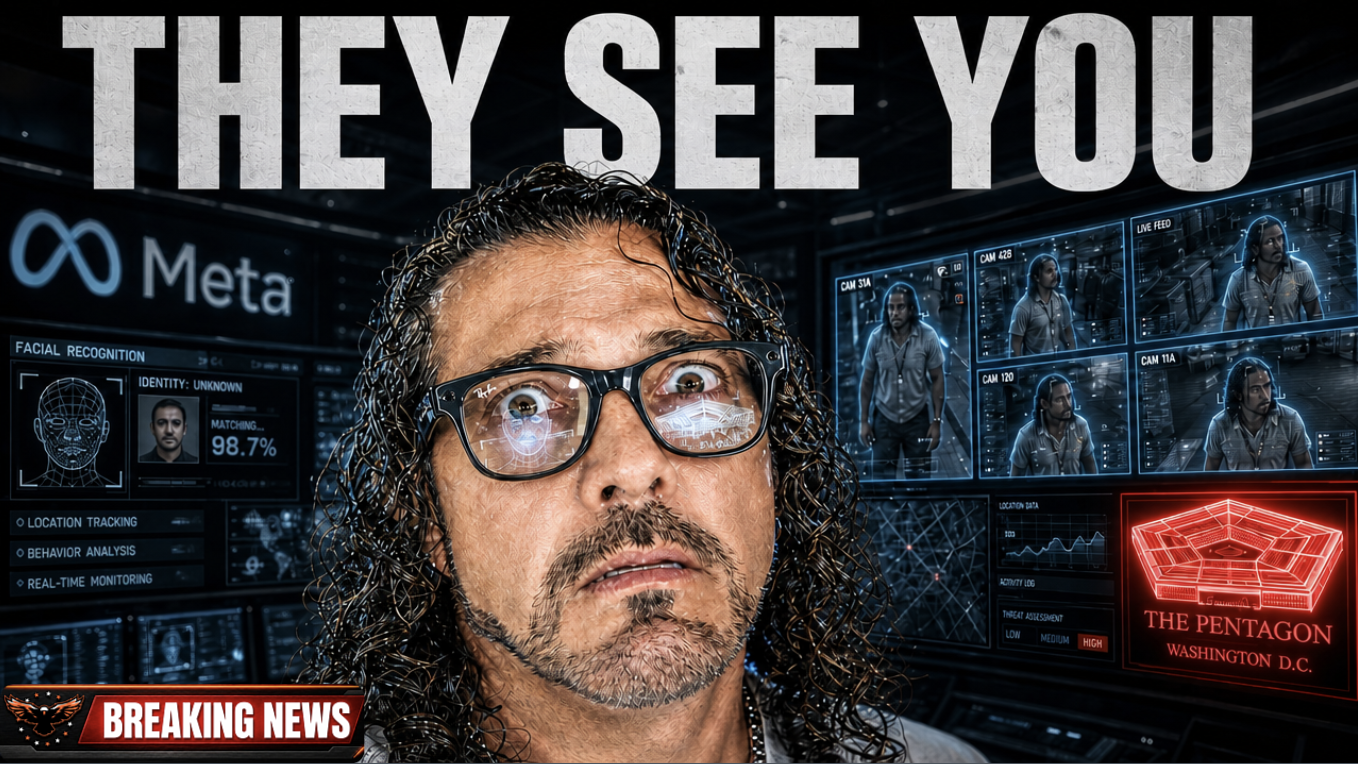
VIDEO TITLE: Meta’s AI Glasses Got BUSTED Doing What?!
DESCRIPTION
Meta Ray-Ban and Oakley AI glasses are now under scrutiny after WIRED reported Meta licensed Rank One Computing facial recognition technology tied to law enforcement, military, and biometric surveillance systems.
Meta’s reported systems were not active for users and were deleted from the app, but the larger question remains: why was facial recognition technology anywhere near mass-market consumer smart glasses?
In this episode, we break down the real architecture behind wearable AI: smart glasses, cloud processing, cameras, Meta AI, biometric vendors, and the privacy concerns raised by civil liberties groups. This is not just a gadget story. This is about the future of public spaces when AI cameras move from phones into eyewear.
🔔 Hit the notification bell and subscribe so you never miss a breakdown!
CHAPTERS
00:00 Meta’s AI Glasses Just Crossed A Line
02:35 What Meta Is Selling
06:35 Subscribe / Sponsor Break
08:45 Who Is Rank One Computing?
10:19 Why This Is Different From A Phone
12:10 The Hidden Architecture
14:00 The Defense We’ll Hear
15:40 The Killer Line
16:350 Final Question
Pinned Comment
Meta reportedly says the face-recognition systems were never active for users — but that is not the part that bothers me. The question is why biometric face tech tied to military/law-enforcement ecosystems was anywhere near consumer sunglasses in the first place.
So where do you draw the line?
Convenience tool… or wearable checkpoint?
HASHTAGS
#Meta, #RayBanMeta, #SmartGlasses, #ArtificialIntelligence, #Privacy, #FacialRecognition, #Biometrics, #Surveillance, #BigTech, #PoliticalPsycho, #JustusKnight, #RestrictedRepublic
Join Us At The Following:
- Restricted Republic News: https://restrictedrepublic.com
- Rumble: https://rumble.com/c/RestrictedRepubli
- Facebook (Justus Knight) : https://www.facebook.com/justus.knight.547/
- Facebook (Lisa Haven) : https://www.facebook.com/lisa0haven
- Instagram (Justus Knight) : https://www.instagram.com/justusaknight/
- Instagram (Lisa Haven) : https://www.instagram.com/lisa__haven/
- Truth Social: https://truthsocial.com/@RestrictedRepublic
- Telegram: https://t.me/restrictedrepublic
I love you all, until next time, Godspeed and God Bless,
Justus Knight
REFERENCES :
WIRED — Meta Tapped a Pentagon Supplier to Prototype Face Recognition for Its Glasses
https://www.wired.com/story/meta-rank-one-computing-face-recognition-smart-glasses/
Oakley Meta AI Glasses — Official Product / FAQ Page
https://www.oakley.com/en-us/l/oakley-meta
Meta — Which AI Glasses Are Right For You?
https://about.fb.com/news/2026/05/which-meta-ai-glasses-are-right-for-you/
ROC / Rank One Computing — Official Site
https://roc.ai/
ACLU — ACLU and 75 Organizations Sound Alarm on Meta’s Plans to Add Facial Recognition Technology to Ray-Ban and Oakley Eyeglasses
https://www.aclu.org/press-releases/aclu-and-75-organizations-sound-alarm-on-metas-plans-to-add-facial-recognition-technology-to-ray-ban-and-oakley-eyeglasses
EPIC — EPIC Urges FTC, States to Block Meta’s Facial Recognition Smart Glasses Plan
https://epic.org/epic-urges-ftc-states-to-block-metas-facial-recognition-smart-glasses-plan/
Because politics isn’t about what they say…It’s about what they’re trying to make you believe. Every broadcast decodes the real signals: what they emphasize, what they dodge, what they repeat, and what they’re quietly preparing you for. From presidential statements to geopolitical flare-ups and economic pressure campaigns, we connect the dots before the narrative becomes “official.”
This channel is built for people who can feel the manipulation — and want receipts. If you’re here for mainstream talking points and safe little opinions, keep moving.
If you want the truth behind the performance…Welcome to the Nation.
COMMUNITY QUIZ
Would you wear AI glasses if they had facial-recognition capability?
A. Never
B. Only if fully offline
C. Yes, with strict controls
D. I already trust Big Tech — apparently I enjoy danger
SCRIPT
Meta’s AI glasses just got busted — and the question is not whether they are scanning everyone today. The real question is why face-recognition tech from a government-grade biometric supplier was anywhere near consumer sunglasses in the first place.
Meta’s AI glasses just got caught standing next to the face-recognition machine.
And before anyone starts crying in the fact-check diaper, let me answer the question right up front:
No, WIRED did not report that Meta is currently scanning every face through Ray-Ban glasses.
That is not the story.
The story is worse.
WIRED reported that Meta licensed facial-recognition software from Rank One Computing — a biometric company tied to law enforcement, military, and government surveillance systems — for internal development connected to the Meta AI app that powers Ray-Ban and Oakley smart glasses.
Meta says it was not active for users.
Fine.
But here’s the real question:
Why was face-recognition technology from a government-grade biometric supplier anywhere near consumer sunglasses in the first place?
Because these are not just sunglasses anymore.
They have cameras.
They have microphones.
They connect to AI.
They send visual data to the cloud.
And now, according to WIRED, facial-recognition code was inside the development chain.
So this morning, we are not asking whether your glasses can record video.
That’s baby food.
We are asking whether Big Tech is building the first wearable checkpoint — and dressing it up like Ray-Bans.
Because the old checkpoint asked for ID.
The new one may just look at your face.
WIRED reported these systems were not active for users. They were dormant. Meta reportedly deleted them from the app on June 5.
Good.
Great.
Fantastic.
Now explain why consumer sunglasses needed a face-recognition prototype from a biometric company with military and law-enforcement ties.
Because that is the story.
Not what was activated.
What was being built.
1:15 — What Meta Is Selling
Meta is selling this as convenience.
Hands-free capture.
Voice commands.
Ask Meta AI what you’re looking at.
Take photos.
Record video.
Translate signs.
Create content.
Get information without pulling out your phone.
On Meta’s own site, Ray-Ban Meta glasses are described as AI glasses with a high-quality camera, simple voice commands, 12-megapixel photos, and 3K video.
Oakley’s Meta page says the glasses have a 12 MP camera, hands-free capture, and a capture LED that signals when photos or videos are being taken.
That is the friendly version.
That is the commercial.
That is the happy little brochure with the guy paddleboarding into the future while a trillion-dollar data company politely asks to borrow his eyeballs.
But when you read deeper, Oakley’s own page says when you ask Meta AI questions about what you’re looking at, the glasses send a photo to Meta’s cloud to be processed. It also says those photos processed with AI are stored and used to improve Meta products and train Meta’s AI, with help from trained reviewers.
Again, that is official.
Not a theory.
Not a fever dream.
Not your cousin on Facebook after three gas-station coffees.
That is the product architecture.
Camera on your face.
AI in your ear.
Cloud processing in the middle.
And now, according to WIRED, facial-recognition code from a Pentagon-linked biometric supplier showed up in the development chain.
Cute little sunglasses.
Massive little question.
The actual text states
The license Meta acquired authorizes use of Rank One’s face recognition along with its liveness detection, which checks whether a camera is seeing a real person rather than a photo or mask. It supports up to 10 million facial templates and remains active. Code reviewed by WIRED shows that remnants of Rank One’s integration—the routines that load its license and initialize its software—remained in a version of Meta’s app that shipped this month, dormant, to millions of consumers, alongside the company’s own face-recognition system.
None of the face-recognition systems tied to Meta’s smart glasses were ever active for users. Meta deleted them from the app entirely on June 5, a day after WIRED revealed that the company had quietly built an unreleased face-recognition system, internally called NameTag, into the Meta AI app—the companion software for its smart glasses, downloaded to more than 50 million phones. The system was dormant and could not be accessed by users.
Meta would say almost nothing about the arrangement, declining to answer WIRED’s questions about its relationship with Rank One. Meta would not say why it licensed the software, when the relationship began, or whether it is ongoing.
Rank One declined to comment for this story.
2:45 — Who Is Rank One Computing?
Now let’s talk about Rank One Computing, also known now as ROC.
This company is not selling “make your vacation photos sparkle” software.
Their own website says ROC is trusted by the U.S. military, law enforcement, and global fintech brands. It lists capabilities including face recognition, fingerprint recognition, iris recognition, gun detection, and license plate recognition.
WIRED reported Rank One derives roughly 80 percent of its revenue from government clients, and that its technology has been purchased by the U.S. Marshals Service and Naval Criminal Investigative Service. WIRED also reported Rank One developed long-range face recognition for U.S. Special Operations Command under a government research contract.
So let’s translate that into normal human.
This is not a Snapchat puppy-ear filter.
This is biometric infrastructure.
This is identity software.
This is the kind of technology that lives in government buildings, law-enforcement systems, security environments, military programs, and surveillance networks.
And now WIRED says Meta licensed it for internal development connected to smart glasses.
That is the bridge.
That is the buried cable.
That is where the loyalty-app story becomes the AI-glasses story.
The loyalty app tracked what you bought.
The smart glasses can potentially track who is standing in front of you.
That is the leap.
That is the line.
And once you see it, you cannot unsee it.
4:10 — Organic Subscribe Break
And this is exactly why we do this here.
Because most channels are going to cover this like a gadget story.
“Meta glasses get creepy.”
“Privacy groups are concerned.”
“Smart glasses are the future.”
Wonderful. Put it on a mug.
But here, we are following the architecture.
Consumer product.
Cloud AI.
Biometric vendor.
Government customer base.
Mass-market wearable.
That is the pattern.
So if you want the version of the news that reads the wiring diagram, not just the press release, hit subscribe and join Political Psycho Nation.
Because apparently the future is wearing Ray-Bans and pretending it is not taking attendanc
5:40 — Why This Is Different From A Phone
Somebody is already typing:
“But phones already have cameras.”
Yes, professor. Excellent work. Gold star. Please collect your Capri Sun on the way out.
Phones have cameras.
But phones usually sit in your hand.
You point them.
People can see you recording.
There is a social signal.
Smart glasses change that.
The camera moves to eye level.
The device blends into clothing.
The recording angle becomes natural.
The person across from you may not know if you are listening to music, filming a video, asking AI a question, translating a sign, or letting the machine analyze the world in front of you.
That is why the ACLU and 75 organizations sent a letter warning Meta not to equip Ray-Ban and Oakley glasses with facial recognition. They called it a threat to privacy and liberty and urged Meta to halt and publicly disavow such plans.
And here is the key.
The danger is not only to the person wearing the glasses.
The danger is to everyone around the person wearing the glasses.
You did not buy the product.
You did not accept the terms.
You did not opt in.
You were just standing in line for coffee, minding your own business, looking like you accidentally survived the economy.
And someone else’s glasses may become the camera, the sensor, the AI input, and eventually maybe the identity layer.
That is the nightmare.
Not “my device watches me.”
That is old.
The new version is:
Someone else’s device watches you.
6:15 — The Hidden Architecture
Here is the system in plain English.
First, they normalize the device.
It is not surveillance.
It is convenience.
It is creativity.
It is fitness.
It is translation.
It is content.
It is safety.
It is accessibility.
Then they normalize the camera.
Everybody is recording.
Everybody is capturing.
Everybody is streaming.
Everybody is “just asking AI.”
Then they normalize the cloud.
The device sees something.
The image goes to the cloud.
The AI processes it.
The answer comes back.
Again, Oakley’s page says photos used for Meta AI processing are sent to Meta’s cloud and stored and used to improve products and train Meta AI.
Then comes the next layer.
Identity.
Who is that person?
What is that place?
What is that object?
What is that document?
What is that license plate?
What is that sign?
What does that badge say?
What does that face match?
That is where this gets nuclear.
Because the moment wearable AI can understand the world around you, the temptation becomes obvious.
Why stop at objects?
Why stop at signs?
Why stop at plants, monuments, and QR codes?
Why not people?
And WIRED’s reporting suggests Meta at least explored that direction internally through face-recognition systems tied to its smart-glasses app, even if the systems were dormant and never active for users.
That is not a small story.
That is not a gadget update.
That is the blueprint for searchable reality.
7:55 — The Defense We’ll Hear
Now Meta’s defense, or the defense from Silicon Valley generally, will probably sound something like this:
It was only testing.
It was never activated.
It could help people remember names.
It could help visually impaired users.
It could improve accessibility.
It could create useful contextual AI.
And some of that may be true.
That is what makes this dangerous.
The scariest technology almost never arrives wearing a villain costume.
It arrives as convenience.
It arrives as safety.
It arrives as accessibility.
It arrives as “this could help people.”
And sometimes it can help people.
That is the trap.
Because the question is never just:
“Can this be useful?”
The question is:
“Who controls it, who audits it, who profits from it, who gets scanned by it, who can access the data, and what happens when the same architecture jumps from consumer convenience into government, finance, policing, and public access?”
That is the same question from the loyalty app.
The app said:
“Here’s a discount.”
The system said:
“Here’s a behavioral profile.”
The glasses say:
“Here’s hands-free AI.”
The system says:
“Here’s a sensor network people voluntarily wear on their faces.”
9:10 — The Killer Line
So no, I am not telling you Meta activated face recognition on every pair of Ray-Bans.
That is not the claim.
The claim is better.
The claim is documented enough to matter and weird enough to make your coffee taste like surveillance.
WIRED reported Meta licensed facial-recognition software from Rank One Computing for internal smart-glasses development.
Rank One’s own site promotes biometric, law-enforcement, military, and security capabilities.
Meta’s own smart-glasses pages promote hands-free cameras, voice commands, cloud AI processing, and visual understanding.
And privacy groups are already warning that facial recognition in mass-market glasses is a red line.
That is the story.
The device is not just a pair of sunglasses.
It is the place where the phone, the camera, the AI assistant, the biometric system, and the public sidewalk all start shaking hands.
And nobody standing on that sidewalk signed up for the meeting.
10:20 — Close
So here is the question for this morning.
When technology companies put cameras on faces, AI in ears, cloud processing in the middle, and biometric vendors in the development chain…
Are we building tools?
Or are we building checkpoints with better branding?
Because the old checkpoint had a uniform.
The new checkpoint has designer frames.
The old checkpoint stood at a door.
The new checkpoint walks past you at Target.
The old checkpoint asked for papers.
The new checkpoint may not have to ask.
It just looks.
And if that does not get your attention, congratulations.
You may already be fully updated.
Categories: Politics


Leave a Reply